Exile, Identity, and the Space Between Chapters
Upgrading the “pause before reacting” module—now with smoother handoffs between awareness and restraint
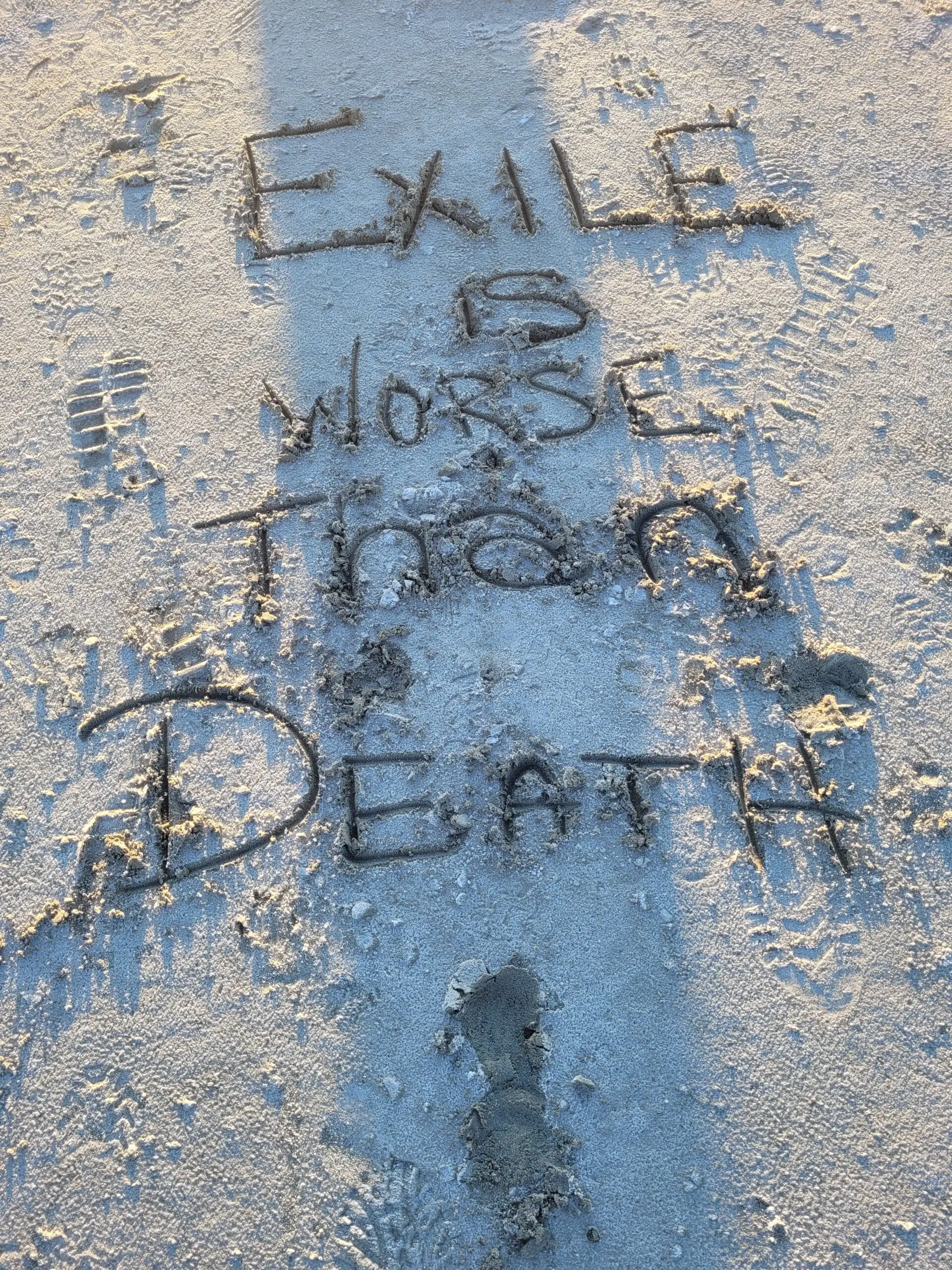
Napoleon said, “Exile is worse than death,” and he wasn’t being poetic. He was naming a truth that sits uncomfortably close to the bone for anyone who’s ever been removed from a system they once animated.
Death is an ending. Exile is a continuation without belonging.
Napoleon understood that. He built his identity inside motion — campaigns, reforms, negotiations, the constant recalibration of Europe. His life was a feedback loop of action and consequence. Exile didn’t just take away his empire; it took away the medium through which he existed. It forced him to stay conscious while the world moved on without him.
And that’s the part that stings.
The Violence of Being Sidelined
Exile isn’t destruction. It’s erasure.
It’s the quiet violence of being told: “You no longer get to matter here.”
You’re not dead. You’re not silenced. You’re simply… removed. The system continues, but it no longer routes through you. The architecture you once shaped now functions as if your absence is the natural state of things.
For Napoleon, that was annihilation by another name. For the rest of us, it shows up in more subtle forms.
Modern Exile Doesn’t Require an Island
Most exile today isn’t geographic. It’s structural.
It’s what happens when:
a workplace moves on without the person who built half the scaffolding
a family system reorganizes and leaves someone standing outside the perimeter
a community shifts its norms and quietly stops making room
a version of yourself no longer fits the life you’re living
Exile is the moment you realize the story is still being written — just not with you in it.
It’s the ache of being present but displaced.
Identity Without the Machinery
Napoleon’s exile forced him to confront the gap between who he was and who he was now. Without the machinery of empire responding to his decisions, he had to sit with the raw, unbuffered version of himself.
That’s the deeper truth inside the quote: Exile strips away the external scaffolding and leaves you with the uncomfortable question of identity.
Who are you when the system that once defined you no longer claims you?
The Strange Gift Hidden Inside Exile
Here’s the twist Napoleon didn’t get to fully explore: exile can also be a forge.
When the old system stops recognizing you, you’re forced to author yourself without its approval. You get to decide what remains, what gets rebuilt, and what no longer deserves your allegiance.
Exile hurts because it removes you from the familiar. It transforms because it removes you from the familiar.
Both can be true.
Why the Quote Still Lands Today
Napoleon wasn’t lamenting the loss of power. He was naming the cost of displacement — the slow, conscious unraveling of identity when the world you shaped no longer has a place for you.
And that’s why the line endures. Not because it’s dramatic, but because it’s honest.
Exile is worse than death because it forces you to keep living in the space between who you were and who you’re becoming.
That’s the real terrain. That’s where the work happens. And that’s where most of us eventually find ourselves — not on an island, but in the quiet distance between chapters.
Some Thoughts, Reflections and Rituals/Activities I Do to not Encounter Similar
When I catch myself in moments where I’ve drifted — not catastrophically, just enough that the edges of my days start to blur — I can feel the old camaraderies of my past trying to pull me back. The carousel of comfort spins its familiar lights. Tempting enough to notice. I acknowledge with purpose that if I intend to move forward with any discipline, I can’t keep entertaining those old enticements. Sometimes I have to face that once‑enjoyed carousel the way one faces an old dragon — steady, unblinking, and willing to say No. That acknowledgment becomes my counter to the system strategies that persist without pause.
Past echoes and present currents blur together, both fluent in distortion, noise, and urgency that only pretends to matter. The modern techniques, the gamifications, the nudges, the little system enticements — each one taps the same repetitive note. They press at my agency until the whole thing threatens to swell into a flood.
Rear‑view clarity arrives right on time — a cue to recalibrate, not retreat into nostalgia or the comfort‑carousel, often stirred by ritual or simple serendipity.
Recalibration rarely arrives as a grand gesture. It shows up in smaller, quieter forms — the rituals I return to, the ones that steady my footing when the noise tries to pull me sideways. Upon purposeful reflection, I recognize that my gratitude is cultivated by the serendipitous disruptions — or the ritual‑prompted intuitions — that distill the noise before the flood of overwhelm rises and threatens the rest and recovery I depend on to meet myself with discipline. Other times it’s the simple discipline of doing the next right thing, even when it feels unremarkable. These are the practices that keep me from being swept into the flood, the ones that rebuild agency one deliberate step at a time.
So I’ve built a handful of rituals that keep me from slipping back into the same loops:
Micro‑pauses — not meditations, just brief moments where I catch myself in the act of living. Rinsing a dish. Crossing a parking lot. Letting the world sharpen for a breath or two.
Rear‑view checks — revisiting old experiences not to relive them, but to measure the distance between who I was and who I’m becoming. A quiet confirmation that the work is, in fact, working.
Story‑tracing — following the thread of a reaction or memory back to its source. Not to overanalyze, but to understand the architecture behind my habits.
Rituals that ground instead of distract — the small, ordinary acts that tether me: morning light, a walk, a moment of stillness before the house wakes.
Temperance through clarity — choosing the next right action instead of the next dramatic one. Letting restraint be a form of strength rather than denial.
These mundane efforts are anything but grand. None of it is optimized. It’s the slow, steady, persistent work of staying oriented in a world that’s built to pull me off course. These rituals keep my hands on the wheel — knowing the sacred will meet me in its own time, not because I rush toward it. That knowing helps me catch the drift early, make the quiet correction, and avoid returning to the familiar ruts I’ve already learned to step out of through active acknowledgment and purposeful effort.
My lived reality — navigated imperfectly — is that these rituals keep me in the story I’m actually living, not the one drafted by forces beyond my reach. They ground me in the space I inhabit — the inner domain Napoleon might have dismissed as too small to matter. That’s where we diverge: he chased dominion outward; I’m learning to tend the landscape within. These practices steady me enough to face the old dragons without climbing back onto their carousels, to ignore the spinning lights, and to walk my path with a clearer sense of where my agency begins and ends. In that quiet tending — imperfect, deliberate, unhurried — I keep moving without being carried off by the currents.
Like Epictetus said:
Every choice has two handles.
These rituals help me keep hold of the one I can actually carry.
- Share:

You may also like
Pressure Is Not the Enemy — Unbounded Pressure Is
- June 10, 2026
- by #ZT
- in Agency, Discernment & Systems

Presence Over Perfection