PDA – An Alternative Distro Among the Ecosystem
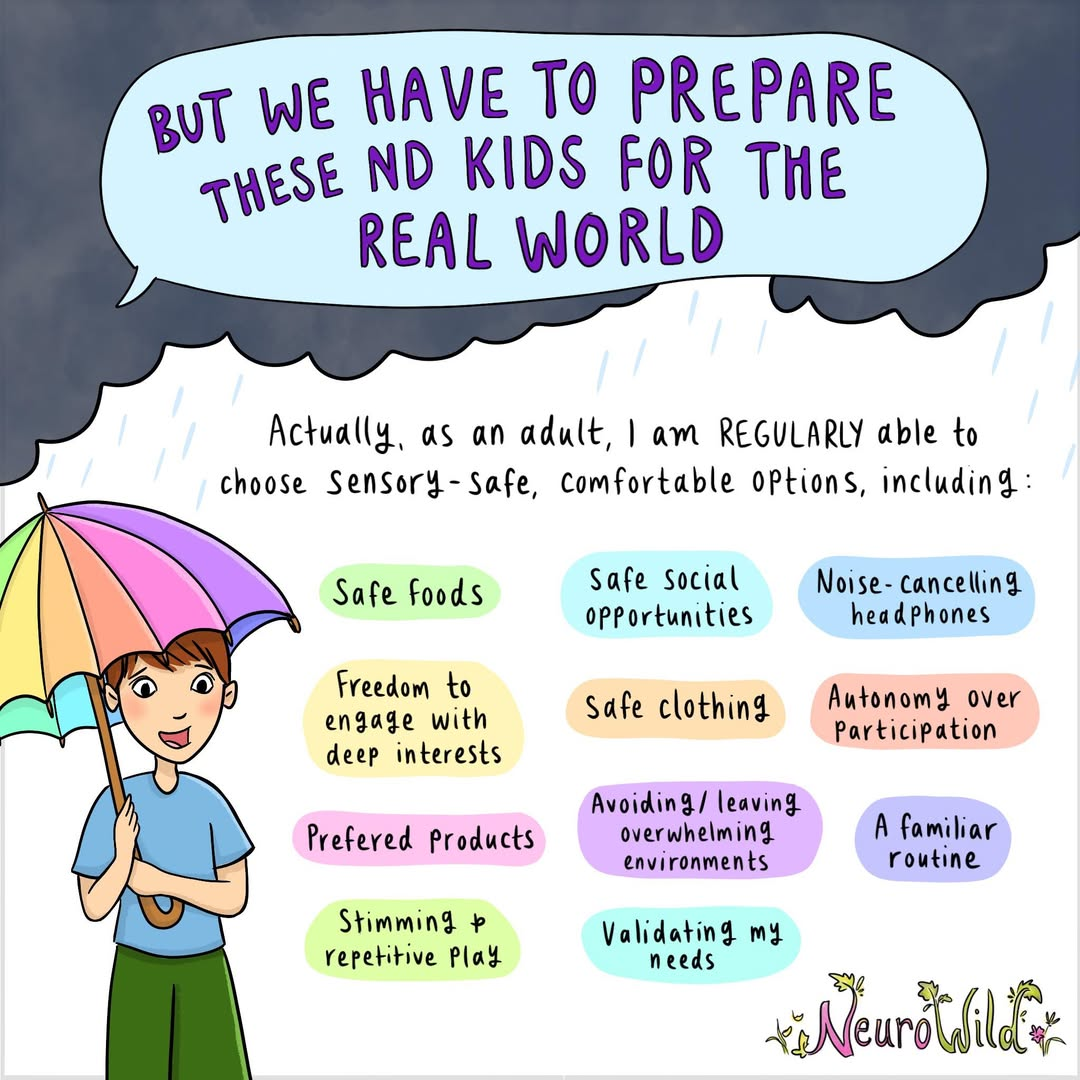
image above from: neurowild
Misreadings and Mismatched Systems
It’s my observation that many people don’t realize how much of life is spent misreading the currents. Those misreadings often assume everyone is swimming in the same direction, with the same strokes, in the same water — as if the current itself were universal. But some of us—and some of our kids—aren’t just in a different current. The deeper truth surfacing now is that multiple operating systems are running at the same time, sometimes even on the same host architecture. I’m one of them. And so is my family.
And the trouble starts when the world insists we should behave as if we’re not.
I didn’t understand any of this until I found myself on the cold tile floor of a Walmart, cross‑legged next to my daughter, who had gone into a full freeze. Not a tantrum. Not defiance. A neurological shutdown. A system overload. A hard crash.
I dropped into my 911 voice—calm, low, steady—not to manage the moment, but to enter it with her. It wasn’t soothing for show. It wasn’t a performance of calm. It was presence. It was connection. It was me meeting her exactly where she was, in the immaturity of the moment, not the performative version of her the world mistakes for “behavior.”
I narrated what was happening so observers — fellow Walmart wanderers — wouldn’t misread the scene and escalate it further. I wasn’t asking for help. I wasn’t seeking intervention. I was signaling: give us space, don’t escalate, don’t harm us. That signal rarely lands, but I send it anyway.
Because my real work in that moment wasn’t with them. It was with her.
I was offering a lamp in the dark—not to drag her out, but so that when she was ready to see again, she’d know exactly where I was. I stayed in the mud with her, in the mush pot, so she could trust that when her system came back online, her dad was right there. Not fixing. Not forcing. Just holding the perimeter until she could find her way through.
It was just me and her. Her fear. Her immaturity. Her operating system.
And my job was to meet her where she was, not where the world thought she should be.
That moment became a hinge. A before‑and‑after. A quiet initiation into a truth I had been circling for years without naming: some people are not built for the world as it is. Some of us are built for the world as it could be—if only the rest of the world stopped insisting we behave like everyone else.
The problem was never the behavior. The problem was assuming we were all running the same operating system.
Misunderstandings at the Heart of PDA
People ask me about PDA like it’s a discipline issue or a behavioral quirk. They’re troubleshooting behavior as if we’re all running the same firmware. They come looking for an “easy‑button” fix — a script, a compliance trick, a way to force the system to behave. They want to know how to “get through” to someone who is “avoiding demands,” as if the whole thing were a negotiation problem instead of a nervous‑system reality.
But the core misunderstanding is this:
I cannot support someone with PDA if I refuse to accept that they are running a different operating system.
Not a broken one.
Not an immature one.
Not a stubborn one.
A different one.
Think Johnny Rotten.
Think Jim Carrey.
Think Robin Williams.
Think David Goggins, Mike Ness, Davey from AFI, Elphaba, Sherlock Holmes (The Cumberbatch rendition).
People whose wiring ran hot, sideways, brilliantly. People who lived in a world demanding linearity while their minds moved in spirals. People who were never going to run the default settings, no matter how many times the world tried to reinstall them.
And here’s the unavoidable metaphor:
Systems often demand people to run life like Windows—predictable, GUI‑friendly, optimized for the masses. But PDA folks? They’re not Windows. They’re not even a single alternative. They’re Linux, yes—but not the polished Ubuntu build people download when they want to feel adventurous. They’re Linus‑Torvalds‑in‑his‑prime Linux—raw, source‑level, “compile your own kernel if you want it to boot” humanity.
And sometimes they’re a blend of distros.
A little Arch. A little Debian. A sprinkle of MacOS intuition.
Maybe even a few lesser‑known operating systems—Haiku, Plan 9, TempleOS—each with its own logic, constraints, and brilliance.
Multiple systems.
Multiple rulesets.
Multiple ways of interpreting the same input.
All running on the same host architecture.
And none of them care whether I know how to use them — they simply run as they run.
Once I accepted that difference—not as a flaw but as a fact—the landscape shifted. I stopped forcing compliance and started learning the terrain. I stopped asking “Why won’t they just…?” and started asking “What’s the current here, and how do I navigate it?”
Acknowledgment became the hinge.
Not agreement.
Not approval.
Not surrender.
Just acknowledgment.
The Taoists and Buddhists figured this out long before any of us:
the river does not apologize for its shape.
It does not explain its bends.
It does not justify its speed.
It simply moves.
And the wise learn to move with it.
The Quiet Labor of Staying Ahead
I am often perceived or described as “patient” or “attentive,” as if it’s a personality trait. It isn’t. It’s labor. It’s vigilance. It’s scanning the horizon for storms before they form. My system is always running diagnostics, even when the screen looks idle. And there is a hidden, unseen cost to that work —An energy expense others treat as default, as if it’s simply how I’m built.They read it as performative niceness, not the disciplined kindness it actually demands.
It’s noticing the micro‑tension in my child’s shoulders. It’s recognizing the early signs of overwhelm. It’s taking the long path around the toy aisle because today is not the day for a test of wills.
This isn’t avoidance. This is stewardship.
It’s the same current Sanni wrote about in that letter to Alex Honnold — the kind of love that looks like effort no one else sees. My wife could write that letter to me. Not because I’m heroic, but because I’m always running the calculations in the background, staying ahead of crises others don’t notice.
It’s not dramatic. It’s not glamorous. It’s not visible.
But it’s the work.
And the work is constant. Not heavy. Just unending.
It’s the kind of labor that becomes muscle memory — the kind that turns me into a quiet architect of stability, the kind that teaches me to read the room before the room even knows it needs reading.
Kindness evolving into a Boundary Protocol - a Heuristic
This shift — this acknowledgment of different operating systems — influenced and shaped more than my parenting. It influenced and shaped how I move through the world.
I’m learning how to assert boundaries without apology. To say, “This is my perimeter. You can operate here, but you don’t get to take this space from me,” unless we’ve built shared consent and negotiation.
And I’m learning to do it through kindness — not the performative kind, but the virtue‑based kind. The kind that requires discipline. The kind that doesn’t flinch when someone pushes. The kind that doesn’t collapse into niceness. The kind that says:
“I will not harm you. But I will not let you harm me or mine.”
It’s like when people say ‘I’m sorry’ while navigating shared space in a store — not remorse, just a social acknowledgment of shared trajectory. There’s no remorse in it. No guilt. It’s not an apology. It’s a quick protocol handshake — a low‑bandwidth acknowledgment that two systems are sharing space. It’s a misused but unintentional “pardon me,” an “excuse me,” an acknowledgment that we’re all wanderers moving through intersecting trajectories. But when I hold my perimeter with that same disciplined courtesy, People misread it as a soft interface, not realizing the underlying architecture is built for stability, not appeasement.
Some people don’t like that. Some push harder. Some mistake kindness for weakness until they hit the boundary and realize it’s steel‑reinforced.
That’s fine. Their misunderstanding is not my problem.
Kindness is not softness. Kindness is sovereignty. Kindness is the old magic that keeps the wolves outside the firelight.
Living With the Current -The Threshold of Possible
Once I accepted that some people — my kids, my spouse, myself — are running a different operating system, the world became easier to navigate. I stopped retrofitting us into templates never built for us. I stopped taking reactions personally. I stopped expecting linearity from a nonlinear mind.
I started living with the current instead of against it.
And in that shift, something remarkable happened: the relationship became possible.
Not perfect.
Not effortless.
But possible.
And in mythic terms, possible is everything.
Possible is the moment the river stops fighting me.
Possible is the moment the forest stops feeling hostile.
Possible is the moment the underworld offers me a path home.
Possible is the beginning of belonging —
that first flicker of connection,
like Neo finally seeing the Matrix for what it is:
the code resolving into clarity instead of chaos,
the world revealing its architecture instead of its noise.

Friction: The Impediment Became the Way
Somewhere in the middle of all this, I watched people argue about theory versus action — who owned the intellectual property, who had the authoritative model, who was doing it “right.” Entire groups split over terminology while caregivers like me were drowning in the day‑to‑day. I wasn’t skilled enough to join the battles, and honestly, I didn’t want to. I needed something actionable, not another debate about frameworks. In PDA‑influenced and PDA‑affirming spaces, I saw more in‑fighting and ego trips than collective movement toward the actual impediment.
Looking back at that Walmart moment — and the library of moments just like it — I can see the leap I made after coaching. At the end, I was a beggar. I asked for what I needed. I received it. The giver had no idea what my next steps would be, and those steps were mine alone. The data, the strategies, the considerations, the exercises — I took them as I needed them. I paid for them, so the value was real. And my spouse received different notes entirely, which means we now wield and tune them together, pairing what we were given into something that actually works for our family’s operating systems.
PDA : One of Many Other Operating System
In the end, this has been the real adventure: discovering that PDA isn’t a flaw or a failure, but simply a non‑primary operating system — one I didn’t choose, one my kids didn’t choose, but one we still have to navigate with precision and respect. The work has been moving from acknowledgment to acceptance to action, learning its logic instead of forcing it to mimic mine, building compatibility through negotiated protocols rather than inherited assumptions. And somewhere along that path, the world softened. The river stopped fighting me. The forest stopped feeling hostile. The underworld offered a way home. Because belonging doesn’t require matching systems; it requires honoring the architecture that’s actually there, and adjusting in real time as it shifts, updates, crashes, or reboots. That’s the quiet miracle — connection that isn’t static but living, recalibrated daily, a co‑processing of the world that becomes steadier, clearer, and more possible with every step we take together.

- Share:

You may also like

Like the old tesla song – Signs, Signs, everywhere there’s signs!
- October 1, 2026
- by #ZT
- in Agency, Discernment & Systems

The Kind of Noise I Still Recognize

You Sound like AI