🌌 Seeking for Honest Giving with Courage and Purpose 🌌
A Season of Celebration - Neurowildnerness adaptations
Midwinter has a way of stripping life to its bones. The veil thins, the light retreats, and every offering—time, attention, presence—lands with the weight of something sacred.
In seasons like this, giving isn’t about abundance. It’s about intention. It’s about courage. It’s about choosing to offer the small, bright thing you do have, even when the world feels dim.
The biggest takeaway for us is how much this approach stripped away the heavy expectations, the consumerism, and the pressure to “do Christmas right.” For our two PDA‑ers (20 and 8), having many small, optional touchpoints instead of one overwhelming event has been a game‑changer. No Elf‑on‑the‑Shelf chaos, no forced traditions—just an unschooling‑style exploration of old‑world practices.
A few years ago we shifted to doing micro‑celebrations from Samhain all the way through the Lunar New Year. Instead of one huge, high‑pressure holiday, we explore and learn and try to understand lots of smaller traditions during this time period: Samhain, Halloween, Toussaint, Calan Gaeaf/All Saints, Krampusnacht, St. Nicholas, Solstice, the 12 Nights of Yule (veil thinning, offerings, ancestor pours), Dziady with a bit of Baba Yaga flavor, Martinmas as a final harvest feast, Álfablót (our private family ancestor/elf honoring – the Elven sacrifice), Lussinatta, Hanukkah, Frau Holle and spinning customs, Hogmanay, and New Year’s Eve.
It’s given them space to choose what resonates, skip what doesn’t, and notice how older traditions echo through modern ones. And for us, it’s turned the whole season into something gentler, more flexible, and far more regulated for everyone.
Now that we’ve built a little library of winter traditions, our four neurodivergent kiddos each get to choose what they want to take part in. It might be pouring mead or lemon‑honey tea water for Odin and his ravens, putting shoes out for St. Nicholas, or laughing while Dad gets “disciplined” by Krampusnacht for not pulling his weight. (We only recently learned that Krampus originally had a more feminine, protective role—less about scaring kids into compliance and more about holding fathers accountable to their families.)
Letting the kids pick their own level of engagement has taken so much pressure off the whole season. It’s helped us reset expectations, lower anxiety, and avoid a lot of the Christmas‑related overwhelm that used to hit hard.
And when extended family starts slipping into authoritative or “should”‑based commentary, we just step away before anyone spirals into dysregulation. We’re not perfect at it, but it’s been a huge shift toward meeting our PDA‑ers where they are instead of trying to force a compliance model that never worked for them—or us.
Maybe some helpful notes in here. This year has been more heavy than ever before, so leading in and with empathy, intention and shifting/adapting with the plot twists and autonomies in our family of 6 is always a chaotic roller coaster-like adventure – but it’s ours and we navigate it the best we can!
A Stoic Meditation - Compass to Navigate the Season
There are moments when concern outweighs desire, when uncertainty presses down with a weight greater than clarity. I find myself returning to this familiar threshold, I am not afraid, but awake, sometimes too awake, hyper‑aware! I don’t often know what to do beyond the next right thing. I perceive, feel, or see. And yet, leaning into the oft unanticipated unknown, I sense growth unfolding. A couple of stories perhaps to illustrate the deep conundrums I face, internally as I journey this thing called life – especially during the seasons from samhain thinning veil and Halloween’s shadows through the Solstice’s long night, into the turning of the year and beyond. And as the year turns, the noise falls away with it. What’s left is the truth we carry into the dark.
🌾 The Widow’s Mite 🌾
The moment that keeps circling back to me this season is the widow with two tiny coins — nothing by anyone else’s measure, everything by hers. The wealthy give from surplus. She gives from scarcity. She steps forward anyway.
I’ve heard this story framed a dozen different ways, but what lands for me now is simple: she offers the thing she can’t spare. Not to be seen. Not to prove anything. Just a quiet act of intention in a world that rarely rewards it.
It’s not the size of the offering. It’s the cost. It’s the courage. It’s the posture of someone choosing to give without waiting for conditions to improve.
Giving in scarcity is an act of hope.
❄️ Yule and Old Ways Echoes ❄️
🔥 Sacrifice in Scarcity
Yule (jól) was the great midwinter festival of the Norse world, held at the solstice when the nights were longest and the sun seemed to falter. It was a season of both hardship and hope: food stores ran thin, the cold pressed in, and yet families gathered to feast, to honor deities and daemons, and to trust that light would return.
Offerings were—and still are—made: mead poured out, livestock given, food shared with ancestors, spirits, daemons, and deities. These were not gifts from surplus, but from necessity. To give in midwinter was to risk, to trust, to lean into the unknown. Just as the widow’s mite was a gift of livelihood, Yule sacrifices carried weight because they cost something real.
🌌 Faith in Renewal
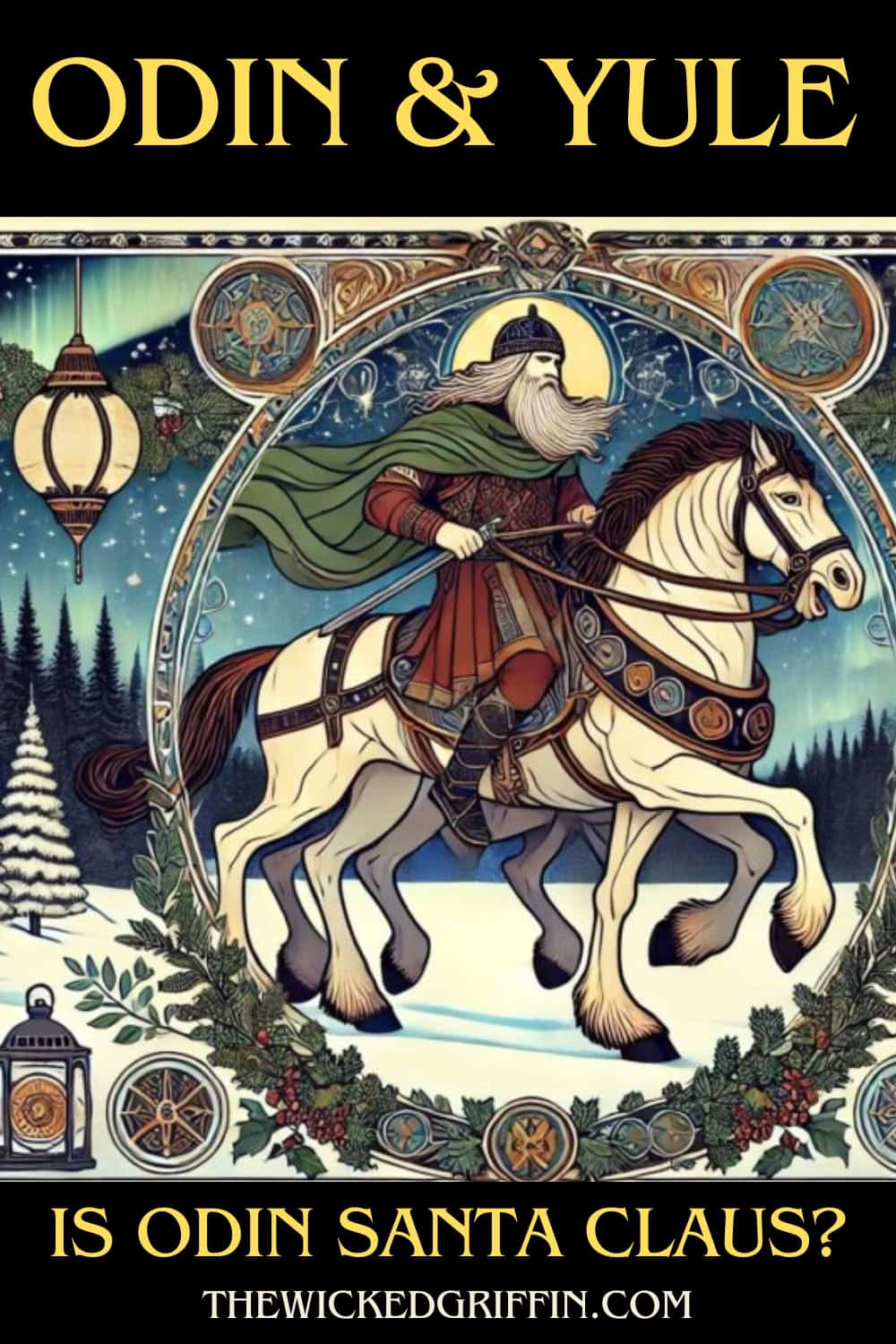
The Norse believed that through these offerings, they participated in the great cycle of death and rebirth, darkness and light. Odin, honored as Jólnir (“Yule figure”), presided over the season while the Wild Hunt swept across the skies. To give during Yule was to align oneself with renewal, to declare faith that the sun would rise again.
The lessons are diverse and timeless: the smallest offering, given sincerely, carries immense meaning. A portion of bread left for ancestors, a cup of ale poured into the earth, a candle lit against the dark—these acts echo the widow’s mite. Both traditions remind us that abundance is not measured in plenty, but in courage, intention, and purpose.
Meaningful giving often rises from scarcity’s cruelties. Giving in scarcity is an act of hope. Whether coins in the Temple or food at Yule, the gift is magnified by the courage it takes to offer it. True abundance is born not of overflow, but of trust—trust in deity, in the cycle of renewal, in the unseen.
Yule is not just a historical festival. It is a metaphor for the inner winters we all face—the seasons when clarity is dim, when concern outweighs desire, when the next right step is all we can see.
In those moments, Yule whispers:
Give what you can. Trust what you cannot see. Light the smallest flame. It is enough.
Yule teaches that generosity is not measured in quantity, but in intention. It teaches that hope is an act, not a feeling. It teaches that renewal begins in darkness, not in light. And perhaps most importantly, it teaches that the most meaningful offerings are the ones made when we are unsure, unsteady, and still willing. And the contrast is sharp when we look at our own age.
📱 The Social Media Illusion 📱
Ryan Holiday observed:
“Almost universally the kind of performance we give on social media platforms is positive. It’s more ‘let me tell you how well things are going. Look how great I am.’ It’s rarely the truth: ‘I’m scared. I’m struggling. I don’t know.’”
Social media is a hall of mirrors. It rewards the loudest signals, the sharpest edges, the most curated versions of ourselves. It trains us to measure worth in attention, not intention.
But attention is a poor compass. It pulls us toward performance and away from presence. It makes us forget that the most meaningful acts are often the ones no one sees — the quiet offerings, the small generosities, the choices made without an audience.
The algorithm doesn’t know how to value those things. It can’t. It only knows how to amplify what spikes, not what sustains.
And yet, the work that actually changes us — the work that builds character, steadiness, integrity — happens offstage. It happens in the unposted moments.
Social media gives us the illusion of connection, but not the weight of it. The illusion of meaning, but not the cost.
Real meaning still lives in the small, steady acts that never trend.
🌱 Rooting Down aka Grounding 🌱
As we dig down into our deep groundings — the why’s — may we seek connection and authentic meaning. May we ignore the prompts and curated shares of platforms that reward performance over truth.
Context creates content. The journey itself cultivates meaning. Destination blindness—fixating only on outcomes—steals joy and transforms life into transactional acts. The widow’s mite, the Yule sacrifice, even the rejected gift of food I once offered on Christmas Eve—all remind us that abundance is found in the act, not the applause.
🥖 A Story: Lessons of Integrity 🥖
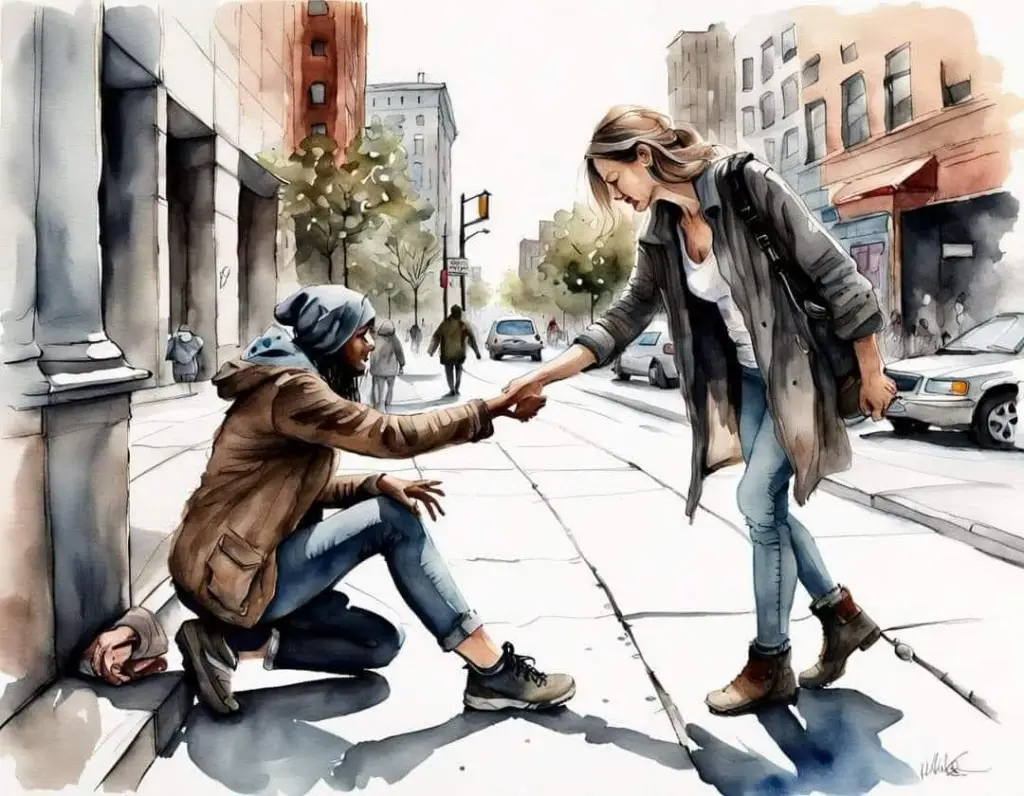
One Christmas season, I offered food to a young man – who was a bit separated from a group who i perceived was in need. He rejected it— I had a moment to ask him why? I wasn’t understanding why would he and the others easily reject the offerings – his response helped recalibrate my intentions deeply!
The rejection was not because of hunger, but because he explained in his own way – his integrity was all he had left. Accepting a gift he hadn’t chosen felt like surrendering the last piece of autonomy he possessed.
And yet, as I departed that now distant scene, he did request the food, and I observed him scarfing down half of a jambon beurre. I was privileged to observe and participate in what unfolded as a transformative moment of disgust transform into joy for him.
This has long kindled a glimmer of hope that would grow through the years, for me! That interaction taught me: giving and receiving are layered with dignity, autonomy, and meaning. Sometimes the gift is not the food itself, but the quiet wonder that arises in honoring the receiver’s humanity—respecting their integrity through consent. It is not about my perception or the fulfillment of my own need, but about meeting him where he truly was. Through the years I have shirked my system of operation and offered folks in need at their requests – their wants and needs!
🌍 Drawing Wisdom from Many Traditions 🌍
A personalized quote of mine. goes like this:
Rather than endlessly debating which worldview is superior, consider drawing wisdom from multiple traditions. Use these insights to shape your own philosophy and personal practice—then let your actions show that collaboration and diversity of thought are more powerful than any single perspective.
I have learned through experience and personal discernment that wisdom may be extracted from many traditions (at once – in parallel or even in isolation) — examples include Stoic, Christian, Norse, modern. Each offers insight into sacrifice, faith, authenticity, and integrity. Collaboration and diversity of thought are more powerful than any single perspective.
It is my lived experience and observation that when we draw wisdom from many traditions, patterns emerge: Sacrifice, authenticity, and trust in the unseen show up far more universally than any curated form of authoritarian certainty. The widow’s mite teaches through parable that the smallest offering, given with sincerity, carries more weight than grand gestures born from excess or ego. Yule reminds us that giving in seasons of scarcity is an act of deliberate courage and hope. Stoicism calls us back to objective judgment and unselfish action in the present moment.
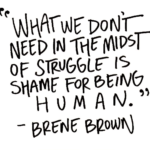
Modern voices—Ryan Holiday, David Goggins, Dieter Uchtdorf—urge us to resist the polished illusions of social media and instead embrace the raw truth of struggle, effort, and growth. Brené Brown captures this spirit in a powerful way:
Together, these traditions converge on a single truth: life is not about performance, but about presence. Not about abundance of possessions, but abundance of heart.
✨ Closing Reflection ✨
These stories and journeys all converge on one truth: authenticity matters more than performance, and sacrifice reveals the heart. This is where authenticity becomes the bridge between traditions. The widow’s mite was not performative—it was hidden, quiet, unnoticed except by Christ. Yule offerings were communal but deeply rooted in survival, not spectacle. And Stoicism calls us to unselfish action, not curated performance.
In scarcity, in uncertainty, in the unanticipated unknown, growth happens. And in giving—whether coins, food, or presence—we discover abundance that transcends measure.
In the end, the widow’s mite, Yule practises of sacrifice, Marcus Aurelius’s call to presence, Ryan Holiday’s critique of performance, the story of a young man rejecting a gift of food on Christmas Eve, and one’s own story of virtue seeking all converge on one truth: authenticity, sacrifice, and trust are the roots of meaningful abundance. Further, giving and receiving are layered with dignity, autonomy, and meaning.
We are not called to prove ourselves to the masses, but to live truthfully in the moment, to give courageously, and to honor both the act and the heart behind it.
Growth happens in the unanticipated unknown. Abundance emerges in scarcity. And wisdom is found not in one tradition, but in the tapestry woven from many.
In this way, wisdom from many traditions converges:
So how do we live this integrated wisdom?
From Stoicism: Practice objective judgment, unselfish action, and willing acceptance of what comes.
From Christianity: Give from the heart, even when it costs us something.
From Norse Yule: Trust in renewal, even in the darkest seasons.
From Modern Reflection: Resist performance, embrace authenticity, and invite connection.
So, let’s do better and be better! Let’s live truthfully, give courageously, and honor both the act and the heart behind it.
So this is where I’ve landed: Give what you can. Give it on purpose. Give it even when the margins are thin.
Not because it’s easy. Because it’s the kind of person you’re becoming.
- Share:
You may also like

Driving From the Rearview: A Stoic Field Note on Discernment, Pressure, and the Work of Staying Human
- May 30, 2026
- by #ZT
- in Agency, Discernment & Systems
PDA – An Alternative Distro Among the Ecosystem


Rather than endlessly debating which worldview is superior, consider drawing wisdom from multiple traditions. Use these insights to shape your own philosophy and personal practice—then let your actions show that collaboration and diversity of thought are more powerful than any single perspective.