
A PDA reflection across a family trip
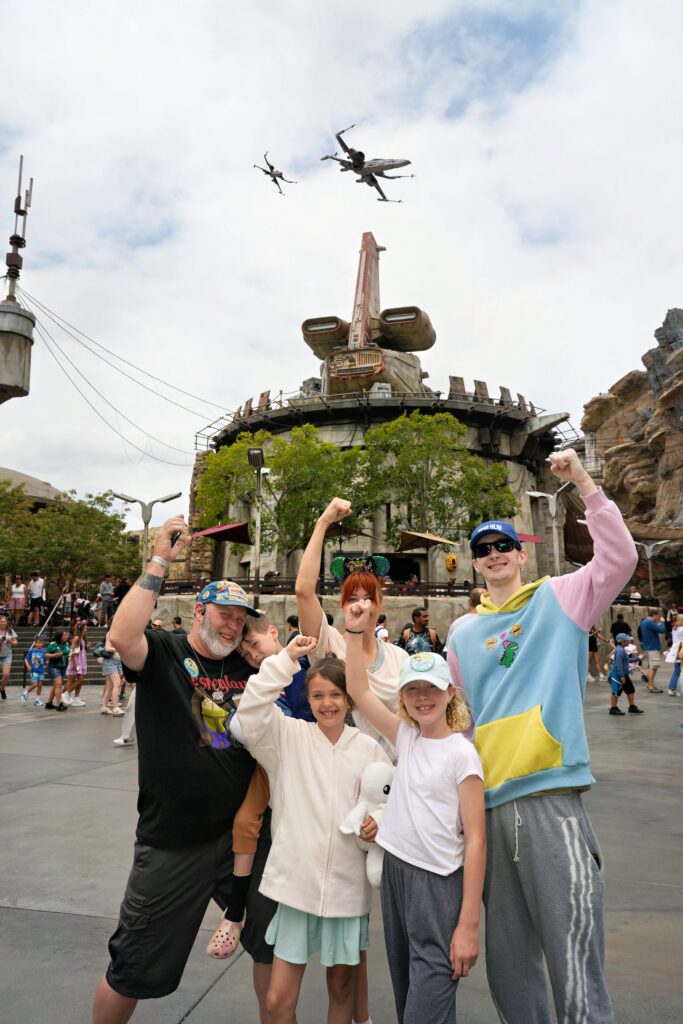


Leaving the park didn’t dissolve anything. The joy stayed, but the load came with us — not as failure, not as regression, but as the natural cost of nervous systems that had been upright for hours inside a structured field. The moment we stepped outside the gates, the scaffolding loosened. Predictability thinned. Transitions sharpened. Everyone’s internal ocean shifted.
My 20‑year‑old went quiet again, but this time the quiet had weight. Not melancholy — more like the after‑tremor of holding it together. My 8‑year‑old’s signals got quicker, sharper, more direct. My wife’s attunement tightened. And I felt the familiar shift: the rest‑field closing, the real world resuming its demands.
Disney makes joy possible. But the return trip always reminds me: joy is not the same as ease.
The load doesn’t disappear. It redistributes.
And that redistribution is where the real work begins — the work of carrying each other back into the unstructured world, where dopamine isn’t predictable, transitions aren’t softened, and sensory density isn’t curated for us.
Even the best holding fields have edges. And eventually, you reach them.


The morning before Huntington carried the memory of everything that had already happened. The residue of Day One wasn’t loud, but it was present — a quiet pressure in our family’s operating space, a narrowing of capacity, a subtle bracing across all nervous systems. Disney is still Disney, and accumulated load still appears. By the final morning, the accumulation had shape.
By the time we woke for Downtown Disney and Huntington, the field had already begun to reorganize. Three days of Disney had stretched all of us — budgets cast away but also expended, adaptations both anticipated and many not, joy threaded through every hour, and fatigue rising at the edges. The dopamine arc was ending, and the reality that the trip was shifting again began to reshape the field. The residue from Day One was still present, but softened by clarity, by truth spoken, by regulation found in what the Disney parks had to offer, by the small pockets of magic that had landed cleanly.

My twenty‑year‑old carried a lighter load simply because the unknowns had been named. My now nine‑year‑old PDA‑er stayed buffered by predictability, still anchored by various park interactions and experiences that had reorganized her system. Even the other two moved differently, sensing the field had more give but also that the next transition was approaching. Underneath all of it, I could feel the subtle bracing that comes when a family system prepares to leave one holding‑field and step into another. Huntington wasn’t a threat; it was simply the next thing. But the next thing always carries weight.
Before we made our way toward Downtown Disney for beignets, the field shifted again — quietly, almost imperceptibly — when my twenty‑year‑old chose to stay back. He recognized his own strain before it tipped, felt the edges of his capacity thinning, and made the call to hold himself out of the next movement. This wasn’t avoidance; it was discernment. A newer, emerging maturity that arrives in him sometimes like this — clean, grounded, self‑protective — and other times not at all. But when it does show up, it changes the architecture of the day. It lets the rest of us move forward without the weight of guessing where he is internally. It lets him regulate without forcing himself into a field he knows he can’t hold. And it lets the system breathe, even if only for a moment.
Downtown Disney carried a lighter feel because of his choice. Not happier, not easier — just clearer. Without the strain he’d been holding, the rest of us moved through the space with a different kind of ease, the kind that comes when one nervous system steps out so the others can breathe. The beignets landed as they always do — powdered sugar, warm dough, a tiny moment of joy that doesn’t ask anything of you. My nine‑year‑old PDA‑er stayed regulated for reasons only she understands — the last sugary goodies, the treats she knew wouldn’t exist once we left the next morning, the fleeting magic that holds her just long enough. The other two drifted in and out of the moment, taking in the lights, the music, the small pockets of wonder that Downtown Disney always seems to offer. And I felt the architecture of the day settle — not perfectly, not without its edges, but in a way that made sense for where each of us actually was.
The drive tightened the field immediately. The residue of the wildland fires along I‑15 was still in our systems — smoke, strain, and the accumulated load of travel. My eight‑year‑old was already struggling; we got turned around, and the Fourth of July build‑up had transformed our usual parking lot into ferris wheels, barricades, and temporary structures. The sudden shift from familiar to chaotic hit her fast. Each “what is happening?” stacked on top of the morning’s anticipatory pressure. The field was already thin before Huntington ever appeared.
Huntington announced itself the moment we went to pull into the lot — and found it closed. Carnival‑sized rides had taken over the entire space, swallowing the parking spot we’d used on every trip before. That single disruption set it all off. The field that had softened through three days of Disney tightened instantly, compacting as predictability collapsed in one sharp moment. Space shrank. The air changed. Everyone’s nervous system recalibrated at once. My twenty‑year‑old shifted into careful neutrality, conserving energy for whatever came next. My nine‑year‑old PDA‑er scanned the horizon, reading the space for demands that weren’t there but suddenly felt possible. The other two hovered in that in‑between place — not dysregulated, just watchful. And I felt my own role activate: the quiet perimeter stance, the widening of awareness, the readiness to absorb whatever friction the beach might surface. Huntington wasn’t magic. It was a threshold. And thresholds always test the field.
We circled the area looking for somewhere else to land, but the disruption followed us like a shadow. Every alternative spot felt wrong in that way only a PDA‑shaped nervous system can detect — unfamiliar, off‑pattern, stripped of the predictability we’d relied on for years. The field couldn’t find its footing. My nine‑year‑old PDA‑er felt the shift immediately, her regulation thinning with each slow turn of the wheel. The other two grew quieter, sensing the tension but not naming it. And I could feel the architecture of the day bending under the weight of that single rupture — the closed lot, the carnival rides, the stolen parking spot, the collapse of the familiar entry point. Huntington wasn’t just a threshold now; it was a test layered on top of a test. And the field was already straining.
We finally found a spot and stepped out, but the field didn’t get a chance to settle before the next disruption arrived. A passerby caught sight of us — or more accurately, caught sight of the moment my nine‑year‑old PDA‑er’s regulation thinned as the beach’s unpredictability hit her. I saw the shift instantly: her posture moved from aloof to “oh, something to capture.” That single tilt of her body changed the entire ecology of the scene. My daughter’s rising friction met the onlooker’s performative concern, and the air tightened. I felt my own nervous system snap into perimeter mode — breath shallow, attention widening, shoulders setting into that familiar readiness. The other two froze in that watchful way kids do when they sense adult tension. And in that instant, Huntington became less about sand and ocean and more about managing the collision between our family’s internal architecture and a stranger’s curiosity. It wasn’t malice. It was misattunement. But misattunement is enough to set the whole field off.

I stepped in before the onlooker could turn her curiosity into action. Not abruptly, not with force — just a clean, quiet redirection of the field. A slight shift of my body, a widening of my stance, the kind of somatic signal that says this moment is held. My nine‑year‑old PDA‑er felt it immediately; her breath caught, then steadied, her eyes flicking from the stranger back to me. The other two stayed frozen in their watchfulness, waiting to see which way the scene would tilt. And in that same instant, I alerted my wife — a small, precise cue that the field had shifted and she needed to step out of the friction she was in. She snapped out of it immediately, her posture resetting, her breath dropping back into her body. That alignment between us mattered. It steadied the moment just enough for the onlooker to hesitate — that half‑second pause where performative concern meets actual uncertainty. It was enough. The field loosened a fraction, giving us the space to guide our daughter toward the waterline, away from the gaze that had tightened everything. Huntington wasn’t offering ease, but it was offering movement. And sometimes movement is the only thing a system needs to keep from breaking.
My wife gathered the other two and moved them toward the waterline while I worked through the residue of the confrontation and the dysregulation still clinging to our daughter. I dropped into my 911 voice — that steady, low‑frequency tone I use to help her know exactly what I’m doing and what comes next. Each word was a breadcrumb, a way of rebuilding predictability after the field had been shaken, and that same voice signaled to the onlooker that the disappointment was real, that we had worked through our moment, and that she was completely absent from the nuanced context required to navigate spaces like this. She drifted off, and the field loosened. We shifted into backpack mode — and my nine‑year‑old became the backpack, clinging to me in that full‑body way she uses when her regulation is thin and she needs my movement to become her movement. Straps tightened, arms wrapped, her weight settling against me as the architecture shifted from rupture to motion. And then we bounded down toward the sand to meet the others who had gone ahead.
My 8‑year‑old’s system was already past capacity — the accumulated adaptations and the morning’s anticipatory demand – eruption imminent. Her nervous system hit the sand still in motion, still searching for orientation, still unable to find a foothold.

Once we reached the shoreline, the field finally widened. All three kids entered the water in their own way — one testing the temperature with cautious toes, one charging forward with the kind of reckless joy only a beach can unlock, and my six‑year‑old drifting toward the breakers with that quiet confidence he carries when the world feels open. All of them entering the space their own way — and the way they sat and intersected with joy, unhindered — that’s what my inner being needed. That widening. That uncoiled moment where nothing was thin.
Our 6‑year‑old, and it was something I missed at first, ventured into the ocean, too. He had watched each of us find connection in the water, and he followed that pattern with the trust only a child carries. A wave caught him — quick, disorienting, the kind of maytag knock‑over I’ve told stories about from my own childhood. One moment upright, the next moment down. The ocean doing what the ocean does — taking you, tumbling you, returning you. Mind you, this was water below one’s knee — but still a stark reminder of its energy, power, and abilities.
My wife saw the fall before I did. One second she was tracking the other two as they frolicked into the water, and the next she snapped into motion — that clean, instinctive stride only a parent makes when the ocean takes one of their kids off their feet. No panic. No theatrics. Just purpose. She moved through the water with the same clarity I remember from my own childhood maytags at this beach, the adults who always seemed to know exactly how far a wave could tumble a kid before stepping in.
And here’s the part that still sits in my chest: she was already carrying the weight of the morning — the drive, the curb spillover, the emotional labor of multiple nervous systems, the suppression of her own. She was carrying all of it. But when he fell down, something in her snapped open. Not a hinge. Not a break‑open. Not the later release she would find driving home. But something. A crack. A threshold. A moment where instinct and exhaustion and clarity collided.
“Forget your perfect offering. There is a crack, a crack in everything. That’s how the light gets in.”
– Anthem by Leonard Cohen
Clothes came off, in a flash, down to her bikini underpants bottom. Then straight into the water. Fast. Decisive. Almost — no, it was feral. No pause. No calculation. Just the truth of her nervous system finally doing something for itself inside the act of doing something for someone else. After the initial shock to my 6‑year‑old was over, she joined him — cold, immediate, unapologetic — and then she went in herself, waist‑deep, as I captured it all on my phone. He had previously surfaced in that stunned, blinking way — half‑surprised, half‑delighted, startled but okay — the ocean’s lesson written across his face. She steadied him with a hand on his shoulder, her breath syncing to the rhythm of the waves. The other two circled back toward them, the field reorganizing around her movement.
Now it was her turn to do similar to his fall, but in her way. She exploded into the ocean in a way I have not witnessed her allow herself to do before. The feelings, the cold, the other barriers of not having the exact right clothes — it was a beautiful moment of embodiment and femininity I was grateful to witness and hold space with her. It was raw and real and needed, for her!
And even though this wasn’t a hinge or a release, something in her softened because the moment was contained — a small exhale, a brief settling, the kind of micro‑reset a nervous system takes when instinct has already done its job. She didn’t walk out right away. She didn’t rush back to the sand. She didn’t fold back into the logistics of the day. She let herself stay in the water — for herself. A emboldened permission. A boundary. A thin break and a moment where she wasn’t absorbing everything.
While she was in the water, another moment unfolded behind us — one that’s almost too familiar in our family’s life. A flock of gulls descended on our beignets, taking advantage of our absence. A local woman stepped in without hesitation, shooing the birds away and saving what she could. When I went to thank her and her group, she said, “Don’t worry. I’d hope others would do similar for me.” As we left the beach, I circled back and told them her gesture gave me hope — hope that feels increasingly rare in our humanity. Her partner and she thanked me graciously, and that acknowledgment stayed with me.
We returned to sand‑filled beignets and laughed — Utah’s state bird had failed us. If I recall, my wife returned to the water for a moment longer, letting the ocean hold her. Our 6‑year‑old had recovered quickly and was full of glee and joy after his abrupt fall. My wife finally let herself have it, even if only for a breath. I stayed on the sand, perimeter activated, watching the moment unfold without interfering. It wasn’t a crisis. It was a recalibration. A reset. A rare moment where the load didn’t collapse her — it freed her, even if only for a second. I captured the moment on my phone and just witnessed her in her moment. All the kiddos that came to the beach were in a moment of joy and living it real time!
The beach became the first place on the trip where the field wasn’t thin. It was open. Huntington has always done this — taken us, tumbled us, returned us. It’s never gentle, but it’s always honest.

As the beach helped us close another Disney adventure, a line came to mind — one that felt like it belonged to the day itself:
“I’ll never forget the ones who came with a lamp when I was in the dark… not to fix me, not to judge me, but to sit beside me until I could see again.”
The woman who cleared the gulls from our beignets was one of those lamp‑bearers. A small gesture, almost invisible in the scale of the day, but it carried weight. She didn’t know our family’s architecture. She didn’t know the load we had been carrying. She didn’t know the thinness of the field. She simply stepped in, quietly, without judgment, and offered a moment of humanity that felt rare.
When I told her that her kindness gave me hope — hope that has been waning — she and her partner received it with a sincerity that stayed with me.
We walked off the sand with grit‑filled beignets, tired kids, a wife who had finally found a moment of release, and a reminder that even in thin fields, there are people who show up with lamps instead of opinions.

And the day wasn’t done. The next micro‑adventure was already unfolding. We weren’t heading home yet.
Bakersfield first — an unplanned but needed visit with my wife’s uncle. Then Sacramento — time with my father. Unexpected stops, but necessary ones. The kind of family detours that don’t fit neatly into itineraries but matter more than the destinations they interrupt.
The trip didn’t resolve anything. It didn’t need to. It simply revealed the truth of our family’s architecture: we move through the world together, each carrying what we can, each releasing what we must, and each finding small pockets of hope in the places that still make room for us.