
Scarcity Brain topics
Gamification and the Scarcity Loop
- Michael Easter explores how modern systems (like social media, shopping apps, and slot machines) exploit our evolutionary wiring through variable rewards and quick repeatability—what he calls the scarcity loop.
- Thi Nguyen critiques similar systems in his work on value capture and gamification, arguing that when we adopt simplified metrics (like likes, scores, or follower counts), we risk outsourcing our values to external systems that distort our agency.
I found the conversation between Michael Easter and Thi Nguyen incredibly engaging—it felt like I was quietly listening in on a deeply thought-provoking exchange. What really struck me was their discussion on how something as seemingly harmless as a TED Talk on gamification could be reinterpreted through the lens of Edward Bernays’ ideas on persuasion.
It brought to mind a personal experience at work when we introduced a gamified rewards app. Initially, it felt fun and motivating, but over time, it began to resemble a subtle form of behavioral control. What’s more, it seemed to obscure the deeper need for genuine recognition and meaningful compensation from leadership. True appreciation should be rooted in a rich, values-driven culture—something we take pride in and share with our customers.
Reading this made me realize how effortlessly these tools can shape human behavior—often without our awareness. Concepts like value capture, the brain’s evolving craving for influence, and the ongoing manipulation of food, diet, and fitness all point to a deeper erosion of personal autonomy. It’s not just about nudging choices anymore; it’s about dismantling the very capacity to choose. In a world driven by scarcity loops, people may find themselves surrendering to punishment simply because it feels more certain than the ambiguity of freedom.
It’s also interesting that Nguyen is portrayed as a contrarian to gamification. He introduces Elijah Millgram’s concept of information overload, highlighting how hyper-specialization fosters a reliance on experts whose knowledge we often can’t fully grasp. Lately, I’ve found myself drawn to the idea of reducing complexity—detuning the chaos and distilling information down to what’s most essential. It’s less about adding more and more about subtracting, simplifying, and focusing on what truly matters.
Trying to gamify everyday life is like handing out gold stars in a jungle — you’re cheerfully assigning points while the vines of chaos, mystery, and moral ambiguity swing wildly around you.
Chapter 6 of Scarcity Brain by Michael Easter
This chapter focuses on how modern environments exploit our evolutionary wiring, particularly through the concept of “variable rewards”—a key driver behind addictive behaviors.
Here’s a concise summary of the chapter’s main points:
Variable Rewards and the Scarcity Loop: Easter explains how unpredictable rewards (like those found in gambling, social media, and shopping) hijack our brain’s reward system. This taps into our ancient survival instincts, which evolved to seek out scarce resources.
Modern Triggers: He draws parallels between slot machines and modern digital platforms, showing how both use randomness and novelty to keep us hooked. These systems exploit the brain’s dopamine-driven feedback loops, reinforcing compulsive behavior.
The Role of Uncertainty: The uncertainty of outcomes—whether in a slot machine or a social media feed—creates a powerful psychological pull. This unpredictability keeps us engaged far longer than predictable rewards would.
Breaking the Cycle: Easter offers strategies to recognize and disrupt these loops. He emphasizes mindfulness, intentional habit design, and creating environments that reduce exposure to variable-reward systems.
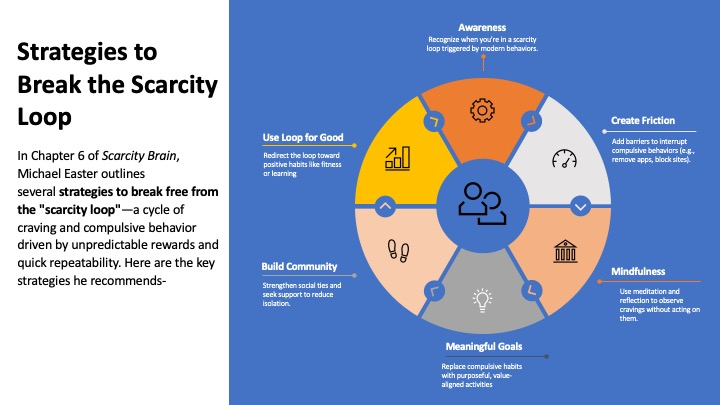
Michael Easter outlines several strategies to break free from the “scarcity loop”—a cycle of craving and compulsive behavior driven by unpredictable rewards and quick repeatability. Here are the key strategies he recommends:
🔍 1. Awareness of the Scarcity Loop
Easter emphasizes that the first step is recognizing when you’re in a scarcity loop. These loops are often triggered by:
- Social media scrolling
- Online shopping
- Gambling or gaming
- Overeating or binge-watching
By identifying the behaviors and environments that activate these loops, you can begin to disrupt them.
Click here for some of my personal thoughts!
🧠 2. Create Friction
To interrupt compulsive behaviors, add friction to the loop. This might include:
- Deleting apps or turning off notifications
- Keeping your phone in another room
- Using website blockers – or dedicating focus time – I find website blockers don’t work!
- Making unhealthy snacks harder to access
Friction slows down the automaticity of the behavior, giving your rational brain time to intervene.
🧘 3. Practice Mindfulness
Mindfulness helps you become more aware of your impulses and cravings without acting on them.
- Daily meditation – practice and repetition is more important than the rites or features – do you
- Mindful breathing when you feel a craving – this polyvagal clue has a lot of options if simple breath work is not enough!
- Journaling your triggers and responses – and this is what I am doing _ I started with triathlon and added in mindfulness!
This builds the mental space needed to cultivate the discipline that empowers me to choose differently.
🎯 4. Set Meaningful Goals
Replacing scarcity-driven behaviors with purposeful activities can help rewire your habits. Some recommendations include:
- Pursuing long-term goals that align with your values
- Engaging in creative or physical challenges
- Spending time in nature or with loved ones
These activities provide deeper, more sustainable rewards.
🤝 5. Build Community
Isolation can intensify scarcity loops. Consider implementing the following:
- Strengthening social connections
- Joining groups or communities with shared interests
- Talking openly about struggles with trusted people
Supportive relationships can buffer against compulsive behaviors.
🔄 6. Use the Loop for Good
Please remember and recall that the scarcity loop isn’t inherently bad—it can be harnessed for positive habits. For example:
- Use variable rewards in fitness (e.g., surprise challenges)
- Gamify learning or productivity
- Create novelty in healthy routines
The key is to redirect the loop toward growth rather than consumption. This is important – and like neurodiversity – ABA or extinction therapy is not always the correct practice to apply.
The TLDR
Thi Nguyen and Elijah Millgram talk about this idea of information overload—how we’ve become so specialized that we now rely on experts whose knowledge we can’t even fully understand. And honestly, that’s messed with a lot of how we function socially today. Take the U.S., for example: politics isn’t really about people anymore. We’re handed a buffet of “freedoms” that look like choices but are really just cleverly packaged influence campaigns. They sell us the illusion of choice, but really, it’s all about manipulating how we think and feel. And let’s be honest—our brains, bless them, are already hooked on social validation like it’s a limited-edition snack.
Maybe the mindful takeaway here is this: in a world full of noise, it’s okay to pause, question the source, and remember that not every expert—or politician—or influencer—has your best interest at heart. Sometimes, the most radical act is just thinking for yourself and seeking for freedom through one’s own personal autonomy!

You may also like
A PDA reflection across a family trip
- August 30, 2026
- by #ZT
- in Neurodiversity & PDA Family Life

A Podcast worth sharing