
Scarcity Loop – Practice Mindfulness
Step 3: Practice Mindfulness
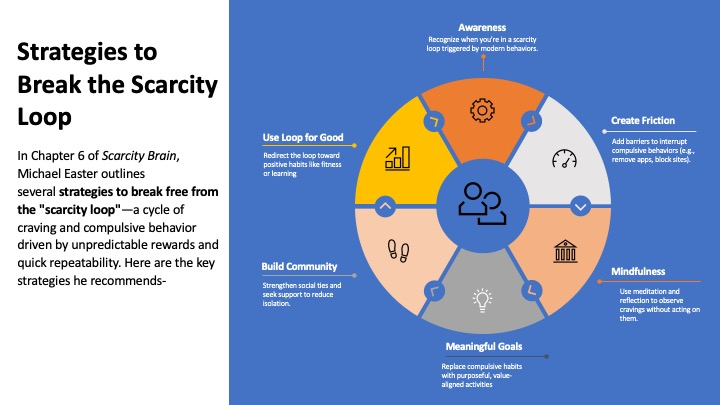
In Chapter 6 of Scarcity Brain by Michael Easter, titled Step 3: Practice Mindfulness, Easter emphasizes mindfulness as a powerful tool to break free from the “scarcity loop”—a cycle of craving and consumption driven by our evolutionary wiring and amplified by modern life.
Mindfulness as a Disruptor
Easter explains that mindfulness helps interrupt the automatic behaviors that keep us stuck in cycles of craving. By becoming aware of our thoughts and urges without immediately acting on them, we create space to make more intentional choices.The Science Behind It
He draws on research showing that mindfulness can reduce activity in brain regions associated with craving and impulsivity. This makes it easier to resist temptations—whether it’s junk food, social media, or compulsive shopping.Practical Techniques
Easter suggests simple mindfulness practices such as:- Breath awareness: Focusing on the breath to anchor attention.
- Body scans: Noticing physical sensations to ground oneself in the present.
- Urge surfing: Observing cravings as they rise and fall without acting on them.
Real-Life Applications
He shares stories and examples of people who’ve used mindfulness to overcome addictive behaviors and regain control over their habits.Mindfulness vs. Meditation
Easter clarifies that mindfulness doesn’t always mean formal meditation. It can be practiced in everyday activities—like eating, walking, or even doing chores—by simply paying full attention to the present moment.The Bigger Picture
Practicing mindfulness helps shift from a scarcity mindset (always needing more) to an abundance mindset (appreciating what we have). This shift is essential for long-term well-being and satisfaction.

My thoughts and Reflections about this step and ritual/practice
I’ve let this rest for sometime and am returning to some things that Easter said about mindfulness — not as a path to transcendence, but as a way to interrupt the automatic loops that run most of my day. The idea isn’t to become a different person. It’s to create just enough space to see what’s actually happening before I get carried off by it.
What stands out to me isn’t the technique itself but the moment of recognition it creates. When I pause long enough to notice an urge — instead of reflexively following it — a small bit of space opens up. In that space, I get a cleaner read on myself. Nothing profound. Just a signal. This is the disruptive pause that signals an opportunity for acknowledgment — a brief interruption where the underlying pattern becomes visible. And once it’s visible, I can see the direction it’s trying to pull me before I’m already moving with it.
The science behind it removes any mystique. Mindfulness dampens the brain regions that fire during craving, which gives me a little more leverage over the pull of junk food, notifications, or the urge to check something “just in case.” When I’m present enough to witness the craving instead of reacting to it, the whole system settles a bit. And in that settling, I can separate things that usually blur together — especially the confusion between anxiety and excitement. That small pause gives me room to parse the two, to decipher what’s actually happening instead of being swept up in the first sensation that hits. It’s not a spiritual practice for me; it’s basic neurological maintenance.
What I appreciate is how plain the methods are. Breath awareness. Body scans. Urge surfing. Nothing dramatic and nothing promising transformation. Just simple ways of paying attention — ways for me to stay grounded instead of getting dragged around by whatever my brain decides is urgent. Many of the emotional or biological currents moving underneath the pressure escape literacy in the moment, and these practices give me a steady point of contact. They let me interrupt the drift without turning it into a performance.
Easter also makes the point that mindfulness doesn’t need a ritual. It can show up while I’m rinsing dishes, crossing a parking lot, or eating lunch without a screen. Nothing special about the setting. It’s just the discipline of noticing — choosing to stay present in the small, ordinary moments I’d normally rush through. These moments act as drift correction, a way to steady myself before pressure starts distorting my read on things. They also remind me of the difference between attention and vigilance: one keeps me grounded, the other keeps me braced. Ultimately, I’m not trying to build an apparatus like a drug addict trying to prevent overdoses; I’m building a fluid and adaptable awareness with access to coping skills and strategies I can shuffle through as needed to face whatever pressure distortion is in front of me. The value isn’t in the activity; it’s in the willingness to pay attention without needing a setup or a story.
And that’s what I keep returning to: the discipline of noticing. Not for enlightenment, but for orientation. To see the loop before it tightens. To recognize the urge before it turns into motion. To create a small moment of choice inside a system that defaults to autopilot. It’s a simple check, but it keeps me from drifting too far into pressure distortion or losing track of what’s actually happening beneath the noise. The challenge will always be that, biologically, the brain can’t compartmentalize stress without discernment and active judgment — the human‑loop element that many machine‑learned systems would prefer I abandon. Small enticements, subtle conveniences, and automated nudges all work to erode personal agency, autonomy, and sovereignty. The discipline of noticing is what keeps that from happening. In the end, it’s a pathway to temperance.
Awareness isn’t enlightenment; it’s basic self‑governance. And given how many systems are eager to “help” by thinking and choosing for me, staying oriented takes actual effort. The discipline of noticing is the one lever I can reliably pull — the small act that keeps me in my own loop. Temperance grows out of these ordinary moments of clarity, not from anything dramatic.

You may also like
A PDA reflection across a family trip
- August 30, 2026
- by #ZT
- in Neurodiversity & PDA Family Life

A Podcast worth sharing