
Experimenting and interpreting observations and informational cues
An exchange around a topic dear to me - stoicism
First context matters – but the who did it and why is irrelevant and I didn’t ask – so keeping this observational and bland. A oft reflected upon thought from Marcus Aurelius surfaced. And this is where I am noting my experimentations and trying to shape things mainly. for me and I am observing the observational cues as they surface. Through another experience – i realised though I had noble intentions I failed and almost lost a friendship over it.
So I am taking the time to note this down mainly for me so I don’t forget and rather improve my personal approach and progress. This facebook clip is one of the reasons I am doing so:
So the following quote was shared:
Because the person to me is in a non primary circle I shared the following – mind you without consent – because i was foolish and didn’t slow down and do that – and this is where the experiement and observations and informational cues began. So I share the following:
This is so often misinterpreted.
“Say to yourself at the start of the day, I shall meet with meddling, ungrateful, violent, treacherous, envious, and unsociable people. They are subject to all these defects because they have no knowledge of good and bad. But I, who have observed the nature of the good, and seen that it is the right; and of the bad, and seen that it is the wrong; and of the wrongdoer himself, and seen that his nature is akin to my own—not because he is of the same blood and seed, but because he shares as I do in mind and thus in a portion of the divine—I, then, can neither be harmed by these people, nor become angry with one who is akin to me, nor can I hate him, for we have come into being to work together, like feet, hands, eyelids, or the two rows of teeth in our upper and lower jaws. To work against one another is therefore contrary to nature; and to be angry with another person and turn away from him is surely to work against him.”
Then in an effort to demonstrate or solicit consent I left this question:
What other stoic thoughts have your attention?
The response was what really got me
Response : I wish I had your time. Frankly, I would never start my day with those affirmations. Therefore, I don’t encounter those people.
The response spurred additional thinking from me
My initial thoughts as I slowed down. First – my thought was – how in the world does this person of influence brush off Marcus Aurelius – at his time he was the Deity of the known world as the last if the 5 Good Emperors before his son Commodus fumbled it all.
Then, upon reflection, I slowed down and turned the lesson to me first. I could do similar like i did previously in my Darwin experience and sharing – without consent – and misinterpreting cues thinking it would be well -received – initially it almost fractured that relationship. I am going to keep my response simple, that’s interesting, how do you accomplish that? I will see below how I internally navigating my self-exploration of this topic.
Think slow - interpreet it all for myself, simplify my social response to engage at interst - aka - MC method of tell me more.
Just to clarify—this isn’t one of my personal affirmations. It’s a direct quote from Marcus Aurelius, specifically from the Meditations as interpreted by Hayes.
The longer citation I shared offers important context that’s often neglected when this passage is discussed. In my experience, many Stoic reflections like this are misinterpreted or lifted out of their philosophical framework, then rebranded as standalone affirmations. That kind of reduction tends to undercut the deeper architecture of Stoicism—its disciplines, its rigor, and the intentionality behind its practices.
As for never encountering people like that… I wish I had that luxury! Clearly, I must’ve landed on the wrong planet 🙂.
And as for having time—I don’t have time either. But I do encounter many situational variances just as Aurelius described. I don’t live in a rose-lensed bubble; when I’ve tried that, hard-earned wisdom from failures and frustrations has shown me that—even without forming an opinion—when harm and safety are ignored, they tend to resurface exponentially.
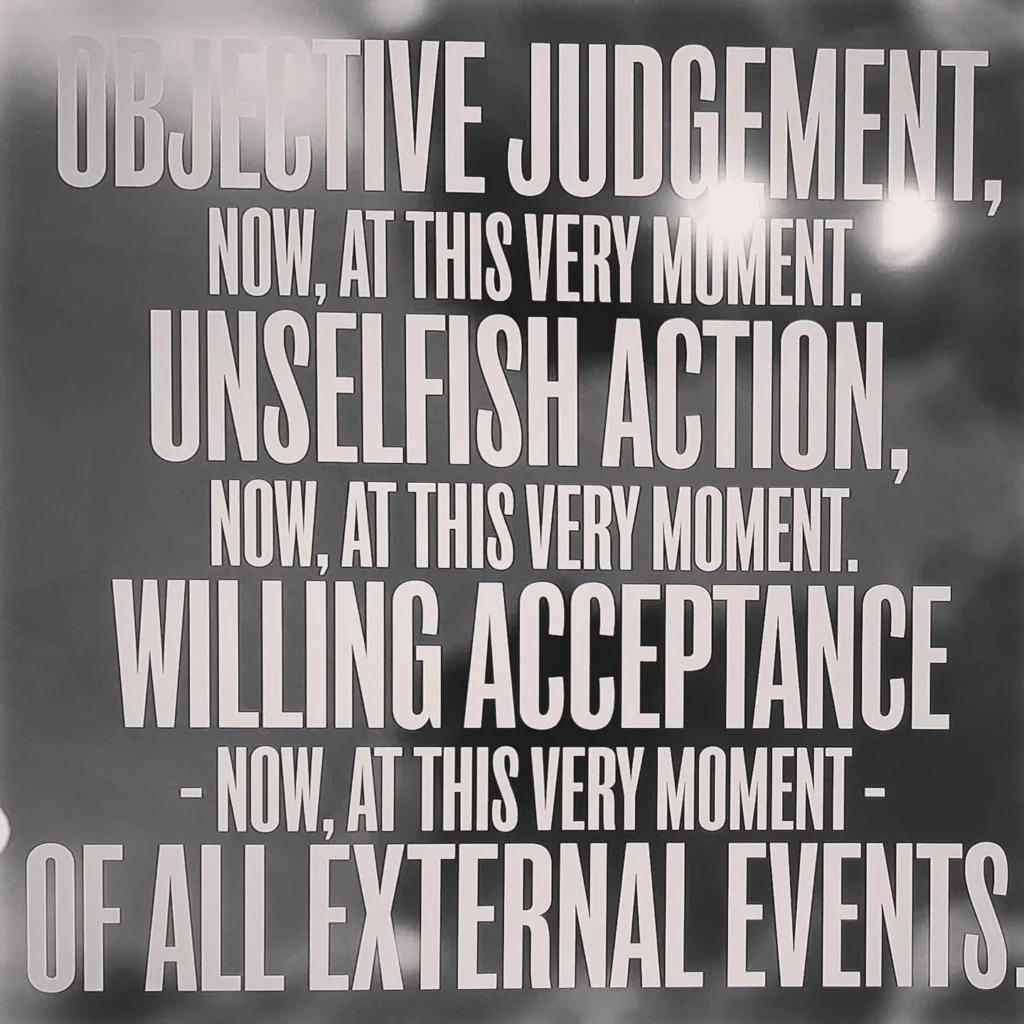
The original citation isn’t about emotional detachment. It’s about practicing a discipline. One that’s beautifully echoed in another of Marcus’ reflections:
Willing acceptance—now at this very moment—of all external events. That's all you need.”
This quote underscores the essence of Stoic practice: making decisions and taking action from a place of rational clarity and present awareness, rather than being driven by emotion or the weight of past experience.
After all that, the discipline to act—and to maintain the discipline of not sharing an opinion—while preserving the virtues of courage, temperance, wisdom, and justice becomes not just a philosophical ideal, but a practical and executable lifestyle. One that stands in stark contrast to the gamified, performative strategies of most du jour paradigms.
What I responded with after the above
You may also like

Top of Mind – Work Sphere Related
- April 22, 2026
- by #ZT
- in !St;ll I Pers;st