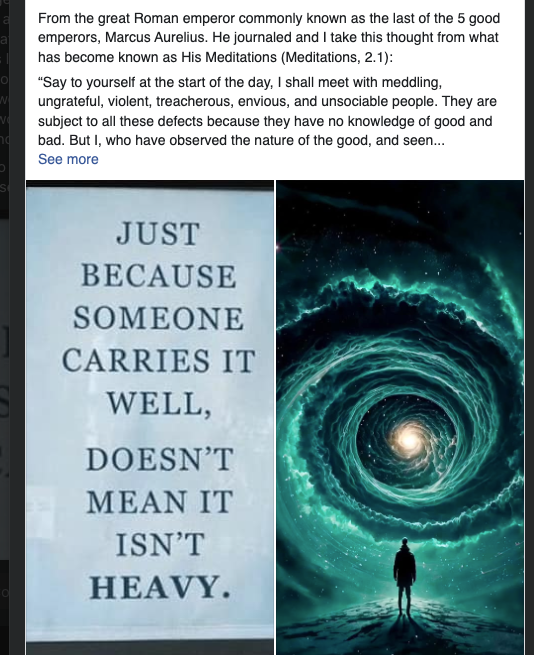
Some days, no matter how carefully I try to carry things, the only sane move is to channel Elsa and just let it go. Not because it’s easy, but because the alternative is dragging around mental weight that was never mine to hold — and practicing the discipline of letting go is, in itself, an act of temperance and clarity.
Marcus Aurelius had a way of naming this reality long before modern workplaces, algorithms, or “leadership frameworks” existed. His line from Meditations (2.1) has been sitting with me again, grounding me in a rear‑view moment that sharpens my present discipline and the refinements it asks of me.
“Say to yourself at the start of the day, I shall meet with meddling, ungrateful, violent, treacherous, envious, and unsociable people. They are subject to all these defects because they have no knowledge of good and bad… We have come into being to work together, like feet, hands, eyelids, or the two rows of teeth in our upper and lower jaws. To work against one another is therefore contrary to nature; and to be angry with another person and turn away from him is surely to work against him.”
Across years, roles, and seasons, I’ve observed this pattern across contexts. And what becomes clear is that micromanagement, control, and “oversight” rarely emerge from kindness or connection. They tend to arise from blind or forced compliance to a system, personal execution preferences often masked as conviction, power, privilege, fear, lack of trust, or a fixation on a target that eclipses the human being standing right in front of them. It often shows up in the language too — the casual “trust me, bro” or “I gotchu, boo” phrasing that pretends to signal care while actually reinforcing control. It’s a pattern I keep trying to understand — not just in my own experience, but in the broader way systems shape behavior.
I can hit the esteemed metric. I can secure the bonus. I can even move through systems that reward those outcomes while watching the human cost accumulate around me — often without cause — and still walk away having learned nothing about what was actually accomplished. I’m observing a new external monster emerge, echoing patterns I once believed were resolved: coherence without discernment, information density without understanding, speed replacing context, and bullet‑point summaries masquerading as actual thinking. It’s something I’m actively trying to navigate and understand, not just critique.
When speed becomes the virtue, complexity gets flattened. When systems optimize for output, they stop noticing the people inside them. And when I trade understanding for efficiency, I drift into a kind of systemic autopilot — one that rewards the appearance of clarity while eroding the real thing. I’m seeing that same autopilot in the rush to adopt the densities of AI without the discipline of proper application — the same way the Mustang’s unibody design looked like progress until real‑world stress exposed the misalignment.
Which brings me back to Marcus Aurelius. He wasn’t offering cynicism; he was offering preparation — premeditatio malorum. A reminder that the world will always contain people acting from their own blind spots, often because they haven’t developed the maturity of wisdom shaped by courage, temperance, and an honest understanding of what justice actually demands. Some haven’t had the failures, the lessons, or the effort that forge discernment. Others are navigating neurotype, trauma, or capability constraints that shape how they move. My task is to stay rooted in what I know to be good, not to be surprised when others don’t, won’t, or sometimes can’t. And to meet those moments with clarity rather than contempt.
Some days, that means letting things go. Not out of apathy, but out of discipline. Out of clarity. Out of the refusal to let someone else’s defects, blind spots, or timelines become mine to carry. And part of that discipline is naming what I will and won’t do: I’m not explaining something “like a five‑year‑old” because performative niceness demands it. I’m being kind by asserting a boundary — and I’m willing to wait, patiently, until there’s effort, alignment, and consent for actual coaching or mentoring. Letting go becomes the quiet act of choosing alignment over reaction — the same disciplined release Marcus was pointing toward, and the only way I know to stay human inside systems that often forget what being human requires.